How fit do you have to be to ring bells?

You only need to be in reasonable health to ring. There is some physical effort required, but perhaps not as much as non-ringers think there is.

The whole point of ringing is to use a good technique; one that requires the minimum amount of effort.  It is very common for people to ring for 3 hours non-stop without being unduly tired.

Harold Rogers, from Isleworth, was comfortably into his 90s and was still ringing 3 hour long peals regularly. Dennis Brock rang for 45 minutes continuously on his 100th birthday!

At what age can you start to learn to ring bells?

Three is no upper age – there are many active ringers who are well past retirement age. All you need is to be reasonably active.

The lower age is not set in stone. In some churches there is a minimum age set for insurance purposes, sometimes 11/12 – though this is not always the case. Please check at your local tower.

With young people it is more likely to be a question of size – both of the young person and of the bells. If the bells are a light ring people will be able to ring them at a younger age than if they were heavy. Ask at your local tower for what age they will be able to start to teach young people

How do I start to learn to ring?

You can find contact details for most churches in the Coventry Diocese from this website. Unfortunately, not all churches with bells have enough ringers to keep their bells ringing regularly. Therefore, if you have any problems making contact with a local tower the webmaster will try to help via email

If you live in the south of The D&N area is to make use of the Darlington Teaching Centre. You can get details via this webpage.

If anyone wishes to learn to ring, or is interested in becoming a teacher, please get in touch with Anthea or Chris Enzor.

If you are not in our area you can find your local Guild/Association from here and look in their website for a place where you can learn to ring. If you are not sure which of these to look for you might try the Dove’s Guide search page, where you can search for a place name, county, diocese, etc.

What does becoming a bellringer involve? 

Many bellringers see the main purpose of being a bellringer is to ring for the main Sunday service(s).  It is nice if you attend this service, but it is by no means compulsory in the vast majority of churches. This ringing usually lasts for 30 minutes or more before the service. Ringers that are not practicing members of the church really enjoy the physical and mental exercise and the companionship that ringing gives them, and will ring for services without attending them

There often a practice on one evening each week, typically between 7.30 and 9.00pm.

There will be plenty of opportunities to do more if you wish to.

Like many things, the more you do the quicker you progress; though please do contact other towers beforehand should you wish to ring with the band on a regular basis so you can improve – they might have their own learners who need a lot of their own time. Most will be more than happy to accommodate you.  Once you can handle a bell safely, why not attend Guild ringing events?

How are bells rung?

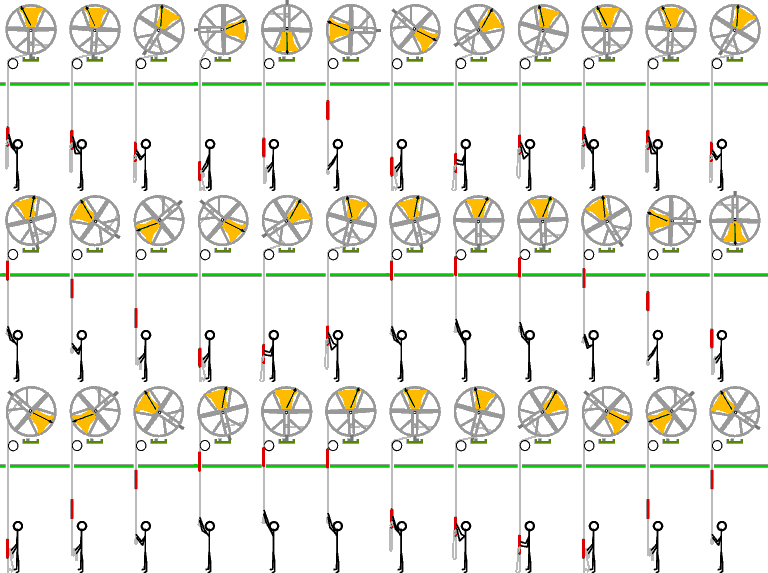
Rounds on Six

(Click on image to animate)

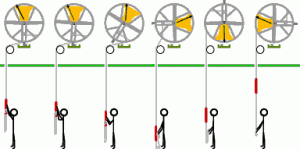
This is how bells are rung. In this image the treble, or lightest, bell is on the left and the tenor, or heaviest, bell on the right.

It shows “rounds” being rung on six bells, 123456, 123456, 123456 ……….. It will sound the same as going down a major scale on the piano; e.g. AGFEDC, AGFEDC, AGFEDC……..

Look at the left bell – notice how the red “sally” is pulled downwards and is then taken upwards as the bell rotates – this is called the “handstroke”.

When the rope is right up the ringer has hold only of the “tail-end” and (s)he pulls this downwards, the sally goes right down and bobs back up and is caught by the ringer; this is the “backstroke”.

In rounds the bells follow each other, leaving an even gap between each bell. You can listen to this clip to hear how it would sound

The green line represents the ceiling of the “Ringing Room” through which the ropes pass to reach the bells in the “Belfry”.

What you can see sticking out above the bell wheel, opposite the top of the bell, is the wooden “stay”, which rotates with the bell, making contact with the wooden “slider”, which is pushed back and forth, left to right and back again. This is the mechanism via which we stop the bells rotating, the bells are called to “Stand”. It is also the safety mechanism. If a ringer pulls too hard and/or fails to catch the sally the stay may break. It is much easier and cheaper to replace the stay than it would be to repair the damage that might have been caused otherwise.

(Image courtesy of Fortran Friends)

Why do people ring bells?

There are lots of different reasons – this is why it can be so addictive!  It is not reserved just for those that are practising Christians, though many ringers are also actively involved in other church groups. There is a physical element to ringing, a mental element, the service to the church community element, the teamwork element and many more besides.

Why not find your local band and ask them why they ring?!

Am I going to be taken up to the ceiling?

To be honest, most bellringers hate “that advert”! It is very rare indeed that anyone is taken up by a rope, even accidentally.

The safety record of bellringing is first class and this sort of thing deliberately is a dangerous behaviour that would not be tolerated.

Please do exactly as your teacher tells you immediately and you will be fine!  There is no such thing as a silly question.  If you are unsure in any way ask that question before pulling on the rope.

How do I move from ringing the basic methods to ones that are more “complicated”?

There are lots of practices out there, some ringing more advanced things than others. Why not go along to one of those? It might be polite to make contact first to alert them that you would like to come. However, remember your own practice night!

You are welcome to come to Association events, even if you are not a member of the Association, when it is often possible to ring things other than you might at your own tower.

Do remember that you can learn methods in your own time – perhaps you might purchase something from the Central Council Publications Committee Bookshop to help you do this?